Showing posts with label Reviews and opinions. Show all posts

Saturday, February 9, 2013

Mr. Ives Christmas

As spring starts (at least in South Carolina!) to show signs of coming, here I am writing about a Christmas novel for a slightly embrarassing reason.  I started it in the fall, got about 3/4ths of the way through, life intervened, then I rediscovered and finished it.  Then writing it about took some real and lengthy consideration.


Mr. Ives' Christmas is about grieving and faith.  The topic drew me first.   The writing held me.

I tend to find other reviews before I write my own, probably to keep from embarassing myself by making some off-the-wall declaration, but despite the fact that I have some weird things to say about the book, things nobody else has hinted about, I'm going to say them anyway:

In a way, it made me think Slaughterhouse-Five meets the Book of Job.

First, for the Slaughterhouse-Five likeness, nothing deep, just a structural likeness.  Just as Vonnegut's Billy is "unstuck in time" and we bounce around his life at different points, so Ives' life comes to us in short non-sequential chapters and often memories, driven by what's on his mind and heart at the moment. Some critics disliked the patchy recanting of Ives' life events, but it seemed to me to be simply the way we remember, and the way we make sense of the present, with whatever pieces of the past our minds connect to.

Some critics say Edward Ives is too Good, but really, he's a believable good man, not a perfect one.  If Hijuelos intended a parallel to Job, Ives would have to be essentially blameless and yet have a gut-wrenching loss visited on him.  And he would be perfectly entitled to question, be baffled by God and "whys." He'd have to feel tormented and damaged.

And he is, both.  But in saying Ives is too good, I think some reviewers miss the very plausible fact that some people turn outward with pain and grief, but some turn inward.  From his unknown birth parents, to the kind, but somewhat emotionally distant, nature of his adoptive father, to, possibly, Ives' innate nature, Ives is clearly drawn all through his life to be one who turns pain inward.

He tries to forgive the killer of his son, and yet tries to keep that at an intellectual level, writing to the kid in prison, sending him books and encouraging him to change the path he was on, but resisting any meeting.  And when the meeting finally happens, he is quite believably untouched by it.  Ives is trying to find redemption through his support of the young man, and it works.  The man does turn his life around, and so Ives has succeeded at making some good come out of the tragic shooting, but it's done with the mind, and isn't a real solution to his pain.

His inner torment over the senseless death of his son manifests in troubled dreams in which he tears at and bruises his own skin.  Healing comes from a dream of his son -- who appears at the age he would have been, 43, not the 17 he was when he died -- questioning him: "Why are you doing this to yourself?" and pouring water on his arms. Ives awakes to find all the damage healed.

The power of God, the existence of the soul and afterlife, are concepts well-supported by the plot, but Hijuelos is way too good a writer to answer the question of faith with a bumper sticker (God did it and that settles it!).  Rather, when faith itself helps to heal, any reader can insist on this being the power of mind.  Whatever.

It's not Ives' only mystical experience, or the only one felt by several other characters.  In fact, his earlier, pre-tragedy, vision of God's loving presence in the world remains undeniable even during the decades that Ives remains emotionally numb over his son's murder.

This novel is not comfortable.  Characters are complex.  Answers are ambiguous.

What makes a novel wonderful?  Different things, to different people, but to me, those ambiguities are what let a varied audience of readers intersect with the characters and with the story, some in very different ways and at different points than do others.  I'm kind of in awe of the power a novel can have to be a place where some people together who otherwise never would, and am more thankful for fiction that grows from someone's soul, than I can quite put into words.

Monday, March 19, 2012

But wait! There's more Jane Whitefield!


Thomas Perry's Jane Whitefield mystery/thrillers have a solid fan base and publishers will probably offer them gladly as long as Perry wants to write them, but they've never become the mega-sellers that some other thriller series have become.

Curious.  They are dark but so are Dennis Lehane's books among many others.  They are violent but so are Lee Child's "Jack Reacher" books.

The "problem" -- if it is a problem -- might be the character of Jane, who's complex and troubled, emotionally strong but still undergoing her own learning process.

That's what I love about the books, but when Jane meditates on the life she's chosen, her parents and the ways they influenced her, what she wants her life to be, maybe some readers get too impatient.

If anybody wants to try this series, I strongly recommend reading the second book.  Either read the first but keep on for one more, before you judge the series.  Or skip right to Book Two.  It was the game changer for Perry.


The first book, Vanishing Act, introduces Jane and it's one smashing good, tense read.  Jane lives alone in her childhood home in an old and quiet town in upstate New York.  But her underground life is one of helping innocent people who have run out of options.

She calls herself a Guide. She helps them disappear and start new lives under new identities.  She provides first quality identity documents and often-frustrating lessons for the victims in how to stay safe in their new lives, resettles each one, and sometimes has to escape or kill the bad guys who are after them.

The novels give a lot of detail about the process of disappearing.  Jane herself has to use multiple identities as she crosses the country to prepare her client's new home, teach him how vital it is to avoid old haunts, old contacts, and old habits.  She's a martial arts expert.  She also, in this first novel, has to win a battle to the death in the forest using strength and cunning.

I loved it.  Another friend didn't.  She said Jane was too unbelievable and perfect.

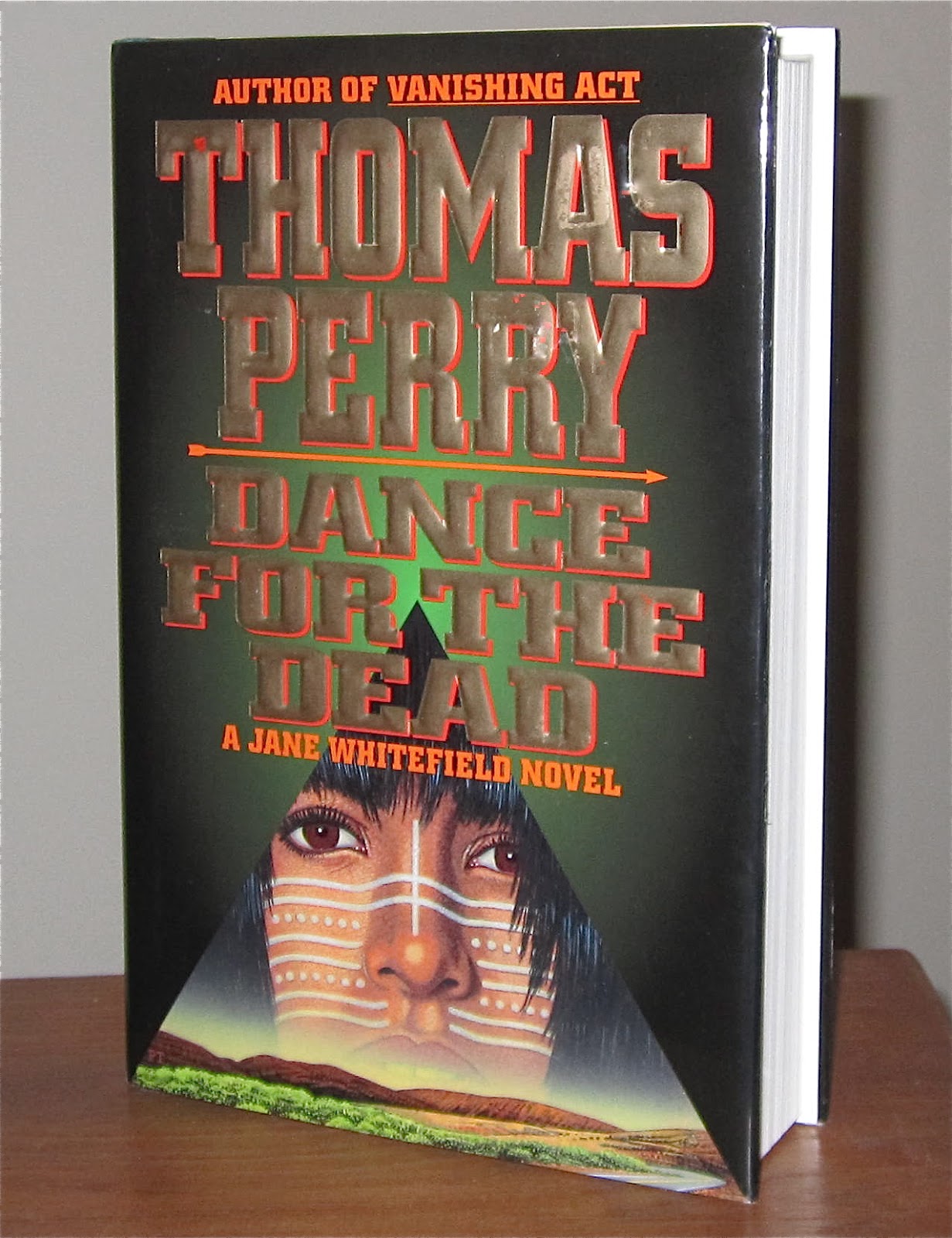
The author seemed to agree because he developed Jane's character in an unusual new direction in Book Two, Dance for the Dead.  The Jane of Book One was a Lone Ranger.  She had a rather unrealistic willingness to live a solitary life with few close relationships.

In Book Two, she's in love.  And Perry decided to let her have a personal life and a marriage.

It was risky idea if he wanted to keep a series going, since life as a surgeon's wife, mother, and Hospital Ladies Auxiliary member is highly incompatible with vanishing under assumed identities at unpredictable intervals, to remain away for weeks as she preps someone for a new life.  Not to mention having to sometimes kill or be killed, an eternal risk.

Perry developed the relationship between Jane and love-interest/husband Carey slowly through a couple more thrillers.  She had to tell Carey about her secret life.  She had to discuss with him the risks of what she did, and she had to come to a willingness to leave that dangerous life, if she wanted a family and community life. Carey had to understand that winding down her Guide business will take time and that it could intrude on their life together while that process occurs.


This still left Perry with a few missions he could take Jane through, even after her marriage.  He came up with a couple good ones, notably one in which Carey's elderly mentor is the one who needs to vanish, and Carey reluctantly requests Jane's help, and plays a role in the mission.

After Book Five, Perry wisely had Jane -- and himself -- take a break.   Extricating herself from the life of helping desperate people escape had to be a slow process, since they hear about and seek her out only through a grapevine that's impossible to shut down quickly, but there was plausibly a stretch during which she was untroubled by runners looking for her.


Runner returns to Jane and Carey several years after the previous book.  She has settled into a serenely ordinary life, but the underground network through which runners hear about her hasn't gone totally silent, and a young pregnant woman comes to her for help.

The mystery and the difficulty of helping this girl make for a white-knuckle read.  Perry has never been satisfied with preserving Jane in amber, though.  She's on her own life's journey, and we have to hear her thoughts about the personal dilemma she's in.

I noticed some reviewers criticizing the way Perry handled the aspect of the plot that involved Jane's personal life, and they have a point.  Here's Jane, in great health and married to a physician, for crying out loud, so why is she bemoaning her inability to get pregnant?  If fertility treatment with a high likelihood of success is available to anybody on earth, it oughta be available to this couple.

I understand that criticism, but I saw it differently.  Jane herself wonders if her constant honing of her body to stay in fighting shape isn't reducing her fertility as it does some female athletes.

And she wonders if she's kept herself in such athletic shape because she unconsciously couldn't give up being a guide.

Perry doesn't settle for easily answering that question because Jane has a deeper dilemma, and a pretty dark one.

She began acting as a guide when she was pretty young, still in college.  Now she realizes that it might have been a lifetime commitment, and that she made it without knowing that once she got into the Guide business, she might never be able to get out.

Is she unconsciously staying childless because she really doesn't want a family...or is it because of a cold knowledge that this door might be closed?

Here's this frightened and endangered girl, who has followed a word-of-mouth trail to Jane that's years old. Will the grapevine ever go silent?  Does what Jane wants even matter?  Did she close off the family-life option as a young and naive woman, without even knowing she was doing so?

A new Jane Whitefield  is on its way!  It came out 3 days ago and my copy is in the mail, but I wanted to post this entry about the previous titles, before I read it.  Pre-pub reviewers are already calling it somewhat disturbing.

It was clear in the last book that Perry has decided to escalate the conflict between Jane's two worlds.  It'll make readers uncomfortable.  It'll probably make me uncomfortable.  But for Jane Whitefield to serenely maintain her mental/emotional equilibrium while her outer worlds come into more conflict would make her that paragon that good writers really need to avoid, so I'll see where he takes it.

Wednesday, September 21, 2011

Books for sleepless nights

I have an insomnia problem.  My version of insomnia usually cuts the middle out of my night.  I'll sleep for awhile, but that 1 AM to 5 AM stretch could find me spending most of it awake.

I decided awhile ago to just go with it most nights (unless life's demands demand that I take a pill), instead of fighting it with over-the-counter drugs that make me feel lousy in the morning, and that (this is totally unsubstantiated) I suspect of making my dreams more unpleasant.

Insomnia advice often agrees with this.  If you can't sleep, just quit lying there in frustrated knots and do something till you're sleepy.

Reading is one of the best things for occupying a sleepless mind without pumping me up and making the mental hamster-wheel worse.

But I'm finding that not every book that I generally enjoy is right for this time of the night.

Your feelings may differ, but I would call craft and project idea books a no-no.  They are more likely to get me pumped up to take an idea get started on a project, than to lull me to sleep.  But if your mind works differently and finds that an idea to implement tomorrow helps you sleep, they might work for you.

I love mysteries, but they tend to gear my brain up.  I love historical novels, but some are depictions of the worst of human history.  Those will aggravate the hell out of me when I'm already restless, with wishing people hadn't been so violent, so power-mad, so shortsighted and that we'd show more signs of learning from the past.

What works, then?

It will be different for everyone, but here's what I've discovered:


1.  A booklight. I read in the dark with a booklight, EVEN if I don't need to - even if I'm out in the living room and a lamp would not disturb my husband.  The surrounding dark keeps me from shifting into daytime mode and I'm more likely to get drowsy after awhile.

2.   Vintage children's books that soothed me as a kid.  The Secret Garden (that's my childhood copy, above), despite its tragic beginning, is about finding that serene place and letting it heal you, and it makes a great book to revisit in a small circle of reading light in the dark. That's just one example - there are lots of them, from Little House to Daddy-Long-Legs.


3.  Gentle, nostalgic humor.   The Peanuts  comic strips that I read and re-read as a kid return me to that safe happy time in my life.  BUT I stay away from biting, dysfunctional humor like Dilbert (which I love as a daytime read), and from anything political.  Dilbert takes me back to the total frustration of the workplace I used to inhabit, and even politics I agree with send me into that stressed feeling about the state of the world.


4.  Comfort Classics.  This will really vary from person to person, but here's what calms me down, and why:

       Jane Austen.  Emma is a delightful book, but takes concentration.  That's good.  In the middle of the night, I have the quiet around me to let me apply my mind to it.  I avoided this novel for years, until I made it an insomnia book, and found that the whole process of concentrating on it stopped the noise in my mind, and the novel was funny and warm while it did so.

      Robinson Crusoe.  One of my favorite books of all time.  Adventure is generally a bad idea, when it comes to sleep-aid books.  But most of Robinson Crusoe is a quiet journey of solitude and slow building.  Like being alone in the dark, Crusoe spends his time learning what matters and what he values, learning how to best use resources, and, most importantly, learning that the long hours alone are NOT useless time, but time when seeds are growing, and the future is building itself between human plantings and prunings and harvestings.  It's OK for nothing to seem to be happening.  It's OK to be alone with one's thoughts.  And it's OK for a store of grains and goods to grow at a natural pace, not all at once.  Crusoe's life is about making that happen over many years, not about having it in place all at once and then sitting and wondering  Now what do I do with my life?


5.  Poetry.  This one is impossible to make suggestions for, since different poets and types of poetry will speak to different people.  Classic poetry anthologies are good for me.  So are Denise Levertov's The Stream and the Sapphire,  and Mary Oliver's prose and poems, which often bring me serenity.


6.  Certain psalms.  I like the psalms in general, but many are cries of terrible pain and might not help with sleeplessness.  This varies from person to person, and some people might find that the psalms of cries to God really help during difficult life issues.  They certainly help me feel less alone, like others have made it through their own hard times with honest surrender to their need for help.  I prefer peaceful ones like the 23rd, for insomnia help.  I bookmark favorites to turn right to, in the middle of the night.


7.  Nature and science.  Now here's a category that you've really gotta personalize.  If there's some aspect of science and nature that fills you with serenity, a sleepless night is a great time to visit it.  Pictures of mountains?  Herbs and flowers? The vastness of the cosmos?


I love glaciers.  Where ice takes on a life of its own, where time slows to a crawl.  The same photos that might make you feel cold and stressed, make me feel calm.   You may prefer volumes on landscape gardens or penguins or wildflowers.  Find what works!

Sunday, August 7, 2011

The Flapper Wife - and her friends


The 1920's.
"Flaming Youth."
Major changes in social life and morés, after World War I.
Wild behavior.
Contempt for the old values and the formal protocols of class divisions and relationships.


Fiction of the 1920's, published right there in the middle of it, can give a more vivid picture than any modern textbook. The Sun Also Rises and Gatsby are classic, and The Beautiful and Damned is, in my opinion a terrific book unjustly relegated to the B-list.


But popular fiction, much now out of print and forgotten, can also take you there. And it can be a lot of fun.

Arthur Train was a New York City Assistant District Attorney, lived in the middle of the Roar of the Twenties, and wrote about legal matters, and about society's collective nervous breakdown.

Train's novel, His Children's Children is, drat the luck, way too mired in the mind of its time to speak across the ages. But it was a serious novel by an intelligent, perceptive and often rather funny writer, whose unquestioning use of the n-word and other racist terms -- not as character insight but in an unthinking way -- ruins any chance it has for perpetual readership, other than as an artifact.

Then there's Beatrice Burton, a bestselling romance novelist of the Jazz Age. As society pretty much broke down after the gore and disillusionment of the First World War, a good contemporary romance had to acknowledge the attraction of life in the fast lane and still present the solid values.

In His Children's Children, a character is brought in merely to give an insightful but long speech about that societal breakdown. It's probably more interesting to us than it was to readers of the time, though at any time, halting the plot for an essay is a dreadful thing to do in fiction. Like I said, a classic, it's not.

This long-winded but wise character dismisses the idealistic pretext for the war, making the world "safe for democracy."

"We sent a million of them over for cannon-fodder to make the world safe for 'business as usual' and the ones who came back are wiser than when they went." he says. And further, he says, that postwar breakdown of the family harms the girls more than it does the boys:
"The reason the boys, as a whole, are nicer than the girls is that the majority of them have been educated at boarding schools, away from their parents. ... You can hire a social secretary to 'bring out' your daughter for you, but you can't hire a woman to be a mother to her and expect to build up moral character at so much per month."

In Train's novel, the daughters are indulged and neglected by wealthy parents, especially a mother who means well but can't see past social success as an avenue to happiness. That's actually about as traditional a value as you can get. A woman's worth determined by the marriage she makes is archaism at its finest. And Train makes it look like the bad idea it is, especially in the eldest daughter's desperately unhappy entrapment in a posh marriage to an English nobleman.

In Burton's novels, the flapper heroines are actually from solid working/middle-class homes with solid parenting, but are lured by the glitter of the high life. Readers could relate to the immature young women in Burton's books -- girls, really -- who craved glamorous material goods, chafed at budgeting, felt caged and bored when told to sit at home instead of going out with some fun-loving boy in his fast and flashy car.

All of these Burton books are practically the same book. Plot elements change, but her baseline plot is one in which a flighty young lady fails to appreciate a hardworking man who loves her and who meets her flirting, overspending and neglect of the home with almost endless patience. When he's on the verge of giving up, she comes to her senses and all is well. In one case (Footloose) she's driven her previous husband to suicide (Nah, no guilt trip there for readers!), but it's still not too late for her to make a life with a Good Man if she wises up.


In several books, the Object of Desire
that symbolizes all to which our heroine
aspires, is a silver toilet set :
sold as gift sets, these featured
brush, comb, hand mirror and often
other grooming accessories.
She's an ordinary girl who owns
the standard "ivorette" or "pyralin"
(both are terms for celluloid) set
that was sold to many a farm and
working class family through Sears
and Montgomery Ward catalogs. The Burton heroine looks down on her Sears lifestyle and wants the Fifth Avenue goods that the equally unhappy heroines of Arthur Train's novel have by the trunkful.


The prices of the high-end goods are just readable at maximum zoom --
But if you can't make them out, the Fifth Avenue suit prices are: $165.00 ; 89.50; and 98.50. In 1923 dollars!


We, the readers, know how hard the father (for single-gal Burton heroines still at home) or the newlywed husband works to give her the nicest things he can, and we hurt for them, especially for the husband, as she spends him into the poorhouse, running up debt on clothes and perfumes and in one case, her own snappy roadster. Through various means, she grows up. She realizes how stupid her values are, how much she has hurt those she loves, and she settles into an appreciation of making dinners and of evenings at home sewing by the hearth with her rat-race-exhausted, but now-happy husband.

Happiness is easy to come by. A young lady reading these books undoubtedly felt that these fine, responsible guys were everywhere, despairing of all the flighty good-time girls and wishing for a good woman. And that all she had to do was to keep a good house, love the celluloid hairbrush because he gave it to her, mend her much-worn frocks, and have such a great guy fall at her feet.

Burton's plots and characters are simple and largely unshaded, but she's smart enough to address women's rootlessness while she provides a simple Return To Domesticity as the healer for it. She acknowledges the attractions that the fast new world holds for girls who have no sense of purpose in this cynical jaded society. But she also brings an essentially smart insight that throwing out the hypocrisy of Victorian society doesn't mean throwing out all commitment, work ethic and honesty, an insight which probably rang true to readers who'd danced at the parties and done the petting and found themselves feeling that life needed something of more substance.

And in Train's novel, Domesticity is also the answer. The eldest daughter in the abusive upper-crust marriage must content herself with motherhood, raising her children in America and remaining legally fettered to an odious husband. Lifelong celibacy is the only honorable option.

So there you have it. Women hunger for something of substance, but to both authors, it lies in the home. In Train's serious novel and in Burton's formulaic ones, the answer is for women to go backward into domesticity, not forward into -- duh !-- education for expansion of the mind and heart. This, even though Train perceived the value education had for the souls of boys.

The Good Ol' Days? Not by a long shot!

------

SOURCES:

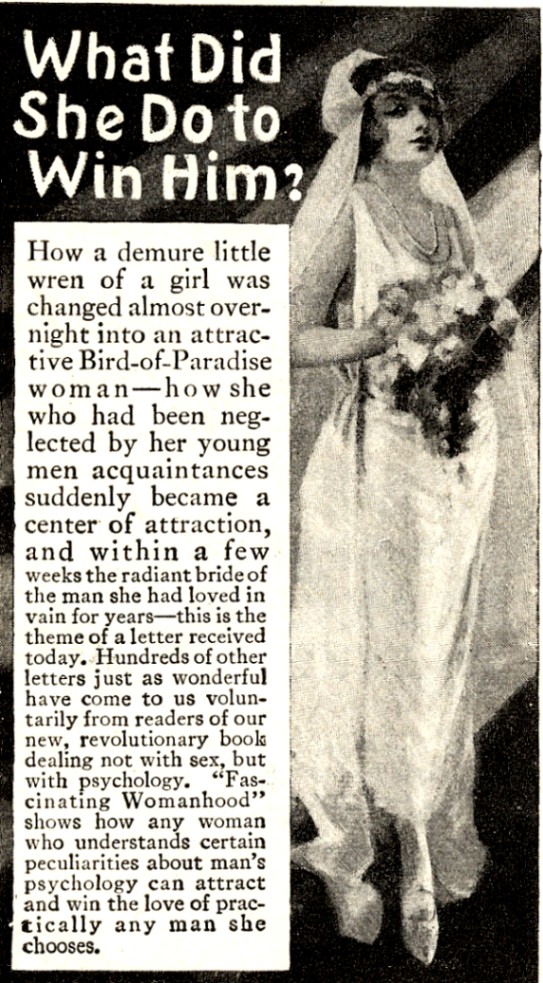
Top illustration is from an ad for an advice book to young women,

entitled Secrets of Fascinating Womanhood.
The ad is found in the June, 1924, issue of Modern Priscilla magazine,
THE magazine of homemaking how-to.

Pyralin items catalog page is from:

1927 Edition of the Sears, Roebuck Catalog: The Roaring Twenties.
Edited by Alan Mirken. Bounty Books, 1970. LC number: 78-108061

Suit illustrations:

Franklin Simon Fashion Catalog for 1923.
Dover Publications, c.1993. ISBN: 0-486-27854-9

and
Everyday Fashions of the Twenties, as Pictured in Sears and Other Catalogs.
Edited by Stella Blum. Dover Publications, 1981. ISBN: 0-486-24134-3

Sunday, July 24, 2011

The Dry Grass of August


The Dry Grass of August seems, at first, to be a simply told, straightforward story. Very reader-friendly, and full of interesting and heartachingly real characters. I found it hard to put down.

That simplicity is deceptive. It’s hard as all getout to put such a novel together this near-seamlessly.

This is the story of the Watts family and their dynamics, their secrets, their major (I know, we’re all sick of the term but) dysfunction.

It’s also the story of the late summer of 1954, in which the chronic tension of southern society during the Jim Crow era is becoming acute. Brown vs. Board of Education has everybody on edge. Violence against African Americans explodes under the pressure that a changing world levies on racists who hate the thought of that change.

Writing good fiction about an important time in history is hard for three reasons.

One is that it’s hard to tell the historic story and still tell a personal, individual story about the characters. They can end up being Symbols of events and issues, instead of people you believe in and care about.

Another is the need to do justice to the historic event. That means finding some way to view events through your fictional characters.

That kind of leads into the third hard part, which is sort of the Boolean intersection between the first two : the point of view problem. How many characters’ points of view will you need to speak through? Can one person tell the whole story or do you need multiple viewpoints in order to avoid having some intrusive narrator stop the story to give a history lecture?

The single point of view of a 13-year-old suburban white girl takes us through this hot and dangerous August. In alternating chapters, Jubie tell us her memories of her family as they grew more prosperous but more emotionally estranged. These memories alternate with chapters that take place during and after a road trip that the family is taking, from suburban Charlotte, NC, through the deep south.

There are four children in the Watts family. The two eldest who drive the story are Stell, 16, and June, “Jubie,” 13.

Author Anna Jean Mayhew’s first smart decision was to avoid making Jubie the gawky, underdeveloped wallflower-type who envies a more-noticed-by-boys older sister.

Jubie is nothing of the kind, and three cheers for that! The sisters fight and differ, but like and respect each other. Jubie is attractive and brave. And so is Stell, whose religious conversion spurs her curiosity about faith. Stell’s explorations lead the sisters into major events in the novel.

Crafting a plot that would take a 13-year-old girl through every nook and cranny that puts together the pieces of this story seems a daunting task to me. Sure, you can contrive ways for a single viewpoint-character to be everywhere she needs to be and see or hear enough to piece it all together, but usually it would seem exactly that. Contrived.

Mayhew solves that problem nicely through a couple of means. The device of the road trip lets us see the dynamics of the mother and children, their reactions to strangers in strange places, their interaction with the Florida relatives they visit, their coping with disaster.

More importantly, this is in part Jubie’s coming-of-age story, and Jubie takes an active part in expanding her own world. She’s smart enough to seek answers without alienating the people of whom she asks questions, and determined enough to go where the answers are, permission be damned. Her discoveries seem not only likely but inevitable.

Racism in the segregationist era had many faces. The Watts family lives the genteel version, in which everyone has “help” and believes that they treat them respectfully. The successful folks in the nice neighborhoods abhor the n-word. But as the Watts family drives through the deep, small town south, they encounter white trash ignorance and violence, and the consequences are tragic when their black maid, Mary, is abducted by a crew of enraged white drunks.

If the novel has a flaw, it could be its lack of an explanation for the beatings Jubie receives from her father. He’s a drunk and sometimes loving but sometimes violent, and of his children, only Jubie is ever on the receiving end of beatings.

Why? Even in the procession of family flashbacks Jubie doesn’t tell us when it started or what the original pretext was. Jubie is a questioner and questioners make dishonest people uncomfortable. That she would be his chosen target is not so much implausible as it is simply unspoken. This omission is kind of like an unpainted spot on a large and otherwise detailed and skilfully painted canvas.

Just as her father finds Jubie more of a threat than he does the other children, Mary finds her more of a kindred spirit, and the bond between the two is one of respectful knowledge and equality. Jubie runs away to attend Mary’s funeral in Mary’s church, and through her eyes we see the strength and world-changing force of the black church in the era of the Civil Rights movement. The black community has questions and will not take silencing for answers.

The officiant speaks on Isaiah 5:24, from a wonderful chapter which rails furiously against oppression and injustice :
Therefore as the tongue of fire devours the stubble, and as dry grass sinks down in the flame, so their root will be as rottenness, and their blossom go up like dust ...
The truth about Mary’s life and death, and the self-evident truth about the civil rights of all people are both coming, relentless as the fire that obliterates the dry grass. It’s August, folks.

Although it contains some horrific events and a pretty frank depiction of a family’s downfall, the levelheaded, sensitive narrator and the respect that the story gives to a panorama of characters give it true class. It’s a great book for teenagers whose parents don’t mind them reading hard realism if it’s done with class. But isn’t geared to teens and some things in it require adult understanding.

This terrific little novel deserves a LOT of attention.

Friday, June 3, 2011

Away, by Amy Bloom. Very rough, very good.

Everyone has two memories. The one you can tell and the one that is stuck to the underside of that, the dark, tarry smear of what happened.

Back in 2008 (!) I wrote about how interested I was in this novel, but how I was annoyed to find that it was written in the present tense. You know: "She walks down the street. She hears footsteps behind her." etc., etc.

It's a trend in novels lately and I really hate it. I mentioned that I was going to give Away a shot anyhow, and I realize that I never revisited the topic to talk about the book.

I'm admittedly a sucker for a pretty book cover, and this lovely cover belies the roughness of this novel. If you do not like violence or explicit and often demeaning sex, you'll probably skip it. I'm more about how the plot adds up, and what it says about the human spirit, and I loved the book.

It takes a young Jewish woman from the slaughter of her family in 1923 Russia, to a tenement on New York's Lower East Side, to life as the mistress of both a wealthy man and his gay son, to a trek across the continent in hope of getting back to Russia to find her missing daughter. The trek involves some acts of submission to people who can help her.

I found Bloom's ability to carry this procession of horrors into such a triumph of the will to love, to be kind of astounding.

Reaction to this book kind of baffles me. Check the reviews presented on Amazon: the Professional Book Folks -- NYTimes, Publisher's Weekly, et al. -- adore it. Readers are kind of lukewarm. There's a disconnect between the literati and readers.

If books are being published to the tastes of the literati and are flunking the reader test in masses, which might have some truth to it, that's an interesting "future of publishing" issue. But in this case, I'm more interested in the fact that Away seems to me like it would not exemplify that problem. Away has much to offer that I'd think readers would eat up. Lots of grim stories show people overcoming the ugly things they face, and many of those are well-loved by readers.

We start with new immigrant Lillian Leyb in New York a year after she survives the violent murders of her family. Her memories of that event come to us in a chilling dead-emotions tone.

Throughout the novel Lillian is chasing a rumor. Word reaches her that her little daughter might have survived, whisked away by neighbors. Further "maybes" take Lillian across the continent, in search of passage back to Siberia where she has heard her little girl was taken.

On the way, she joins temporary forces with a lot of characters. They have their own stories, and while she spends a few weeks or less with each and then goes her way, the author often takes a brief timeout from Lillian's story to give us a quick wrap-up about the entire rest of each secondary character's life.

It does take "omniscient narrator" to the extreme, telling us vastly more about the panorama of characters than Lillian could ever know. In one case, it even takes omniscience into an alternate history; as she slogs her way through the Alaska wilderness Lillian happens across three young children alone after the sudden death of their mother, and Bloom tells exactly how the children would have died, one by one, if Lillian hadn't walked up to their cabin.

All these expansions of the other characters' stories wowed me, because they make this slim novel much bigger, about not just one woman, but about America growing and building itself out of violence, endurance, chance, and stunningly raw material.

Without spoiling the plot ---- well it's difficult not to spoil the plot and still tell why I liked the book so much, but it balances harsh realism and successful endeavor.

Lillian seems to have kept her spirit and basic decency alive through everything. Is that realistic? Can you whore and kill, and still come out with your soul intact?

Lillian repents of practically nothing. With beautifully crafted psychological realism, Bloom shows us that Lillian's belief in God doesn't so much end as it deteriorates. A spark of some life force is still there, but so rudimentary that, if it survives at all, the shape it will take later in her life could have most any form:
...Lillian does not believe in anything like God. She's petitioned particular gods lately (the god of edible berries, the god of slow-moving streams), but she doesn't address or hope to be heard by the Creator of the Universe. Lillian believes in luck and hunger (and greed, which is really just the rich man's hunger--she doesn't even mind anymore; that people are ruled by their wants seems a reliable truth). She believes in fear as a motivator and she believes in curiosity (hers should have shrunk to nothing by now, but feeds on something Lillian cannot make sense of) and she believes in will.

Bloom isn't interested in making the reader comfortable with Lillian's actions. She writes Lillian, not as uncaring, or as so singleminded in her quest that she's indifferent to others' pain. She killed the pimp to save her friend's life, but resists taking his watch. She wouldn't "leave Seattle like a grave robber." But repentance is another matter. Lillian's need to find her daughter overwhelms all else.

The author takes the harder track through the simple facts of violence and its aftereffects, through choices as people perceive them, whether they perceive them accurately or not, and all against a backdrop of the feeling that time, like the kindness of strangers, must be exploited before it exploits you.

Would I call the ending a success story? Does a life driven by love always go where it's meant to? That aforementioned author omniscience tells us stories galore but never tells us any big cosmic whys.

As for the present tense, I still think that in a lot of novels it's getting used because it's trendy and sounds Terribly Deep and literary, but in the case of Away, it helps the reader understand Lillian's desperate, driven feeling.

I'd call this novel highly discussable! It's also short. It's also highly "accessible" which is literati talk for readable. I think it deserves more attention than it's had so far, but my taste may be weird.

Tuesday, April 26, 2011

An awful lot of a good thing


Persuasion is my favorite Jane Austen novel. I appreciated her more with my mind than with my heart, until I got to this one, and it's the book I recommend to people who say they can't get into Austen. It's quiet and dark and more about inner life than about outer, although, as in every Austen book, it's about both, the interplay of the two.

The story is driven by what I think of (in negative moments) as the plague of having to live in linear time. You can't know the future so you have to make the best choices you can without knowing for sure whether they really are the best, and you can't change the past once you've made them. Not an uncommon dilemma in stories but wonderfully realized in this tale of a young woman persuaded not to marry the love of her life, not by those who have no concept of true quality (Anne's or her beloved's), but by the person who loves and respects her the most and who genuinely fears for her happiness. Right and wrong choices are so very hard to define sometimes, even after the fact.

I love this book. So when I saw that there was an Annotated Persuasion, I jumped on it.

And it's really a cool resource. It's not perfect. I can't imagine that anybody reading Austen's books at all, much less this one, needs a note telling them what "amiable" means.

But there was great stuff in it. I now understand the relatively lowly status of a curate, and of an attorney as opposed to a barrister. The idea that for widows to remarry -- I don't mean in haste, I mean, ever -- was considered not...quite proper was new to me.

It's got some nifty illustrations too.


So that's what a "pelisse" is.

But i was hoping it would replace my nice, mundane little copy of the novel, and it won't. It's too much, as a reading copy. This is absolutely great for students, or for anybody who just wants more, but that's studying, not reading. The format -- text on the left-hand page and notes on the right -- bothers me. If that were reversed, I could possibly read a novel only on right-hand pages. Turning the page when I come to the end of a right-hand page is very natural, but not when I've just finished a left-hand page. I think the publisher should have reversed this.

So much for not expanding my book collection. (grumble) I'll be keeping both copies. The extras in the Annotated are too good to discard, but it's too hard to just read for pleasure.

Tuesday, April 5, 2011

It's also Grilled Cheese Month!

Complete with a new, all grilled cheese, all the time, cookbook!


Amazon
Books-a-Million
Barnes & Noble
IndieBound


Nice review in the Christian Science Monitor.


I don't know if my favorite is in there, since I just found out about the book (and the month) 10 minutes ago, but for a terrific grilled cheese sandwich,
assemble in logical order :


- DARK pumpernickel bread
- UNSALTED genuine butter, lightly spread on the bread
- Gouda, or smoked Gouda cheese - at least 2 slices thick. 3 is good.
- honey mustard.

Happy April.

Tuesday, February 1, 2011

Book therapy

[NOTE: This is a previously published entry, copied from my original blog.]

--

No, this book is not therapeutic. Interesting, yes, but uplifting ... no.


This absolutely charmed me in the bookstore. Then I read it.

It's categorized as a graphic novel, though it has pages of straight-out text. Makes it look like a kids' book which it absolutely, emphatically IS NOT. Graphic novels is the best category for it.

It has a totally cool concept. A discontented young woman roams the streets at night and, one night, encounters a mysterious bookmobile that runs only at night.

It's her own personal magic bookmobile, run by her own personal otherworldly librarian. It contains every book she's ever read. Actually, it has everything she's ever read, including letters, cereal boxes, etc. Only what she's already read, nothing she should, or wants to, or would want to read. Just her past.

Is this an awesome idea? What a great way to get in touch with her lost self.

So I think it's going to be a charming story about...what? the healing power of books? revisiting your past and reconnecting with your old dreams and fantasies, and how that can help you get your life unstuck?

No. It's about how avoiding Real Life relationships and achievements by book obsession, like any retreat from reality, can be sick and destructive.

And though charming, it's not, it is food for thought, which is what a book should be. But, while getting the message, one of my thoughts was, Boy would I write a different story if I came up with this idea.

If it were up to me, the heroine, when told she really cannot just leave the regular world and live in the bookmobile, would buy an old RV and start her own, everyday-life Bookmobile.

And if she didn't go that route, still, I'd have the otherworldly librarian suggest it when she expressed her discontent with her life and asked to stay.

She couldn't supernaturally amass the books of someone's life, but she could stock her 'mobile with all the books that she loved, books that helped her and fed her soul through hard times, and she could set out to help unhappy night-wanderers by finding just the right book for them.

This, of course, is my concept, not the author's. Freedom of speech, right to say what she wants to say, yadda yadda, but I like my concept vastly better.

What I would put in such a bookmobile could be a whole post, but here's where I'd start:


The Oxford Book of Eighteenth Century Verse.

I often say that writing a novel doesn't mean I know diddly about literature. It's not modesty, it's the truth, and when I have an impression of some genre or period in literature, I'm likely to be simpleminded in the extreme and to embarrass myself by voicing it, but I'll go out on a limb and say this :

18th century poetry is, like, the Intermission in literary history, where you can take a break between the religious poets and their Journey to Death, and the Romantics and their "My Love is in The Grave" and Life's Fragility, and just go have a Coke and candy bar in the warm light of the lobby.

Sure, some poets of other eras get happy and some get serious here too, but so much of the book is loaded with humor --often deliciously biting humor-- joy, and hope. There's a whole, admittedly "the Titanic is unsinkable," kind of feeling that the amazing discoveries we're making about the cosmos are the beginning of our mastery over pain, wear and decay, injustice and conflict, everything. Life still hurts but there's light ahead; Reason will banish it all.

So far, all that optimism is quite unfulfilled, but mostly, reading this poetry is a joyful interlude.

So I'd certainly have a bunch of copies of this in stock. "Feeling low? Dip into this."

Thursday, April 30, 2009

Sue me. I love Peyton Place

[NOTE: This is a previously published entry, copied from my original blog.]
--


Our friend Leila often spends holidays with us and brings interesting videos when she comes. On Christmas day this year, after the Big Dinner with my folks, we came back and watched an episode of David Halberstam's documentary series, The 'Fifties.

Specifically, we watched the episode about Grace Metalious and her phenomenal bestseller, Peyton Place.

I'd never before felt any interest in Metalious or her book, but her personal story grabbed me. Her complete lack of emotional or educational background for writing, and her determination to do it anyway, drew me in. And then, she didn't just do what her soul longed to do, she did it successfully, at least in terms of sales and celebrity. And never had more than a moment's happiness from it.

Possibly because of the endless TV series, which seemed to be on nearly every night when I was a kid and bored me then, I'd also never had any desire to read the novel. My assumption was that it was both trashy and tame, an artifact of its time that may have been an "adult book" in 1956, but had neither the wickedness nor the literary merit to make it interesting reading now.


I was wrong.

Not entirely. The book is amazing and often awful. It's a crazy-quilt of the lurid, the overly campy, and the insightful. Some of the vignettes in it delighted me, and the best of those are the smallest, not big plot points.

In an early one, two friends, twelve-year-old girls, spend an afternoon together. That's it. Allison is from an (outwardly, but with secrets) proper home. Selena is from an abusive home in a tarpaper shack on the wrong side of the tracks. Their friendship depends on their shared dream of a someday in which each can control her own destiny. But on this occasion, Allison wants to share with Selena a previously hidden aspect of her inner life. She wants them to take, not the usual walk downtown where they buy Silver Screen magazine and dream of pretty dresses in store windows, but one to the wooded glen where Allison goes to daydream about a bohemian literary future. Allison and Selena both feel like outsiders. The glen, outside of and above the town, is Allison's symbol of how outsider status can be superiority, a breaking away. Selena wants to achieve insider status, and can't relate at all to this place or its meaning for Allison.

The afternoon is a disaster. They wander back downtown. In a little chapter in which the pacing is crucial to the depiction of these two mending their friendship by reentering the part of their lives that they can meet in, Metalious nails it. Through ordinary window shopping and ice cream, they gradually find common ground again and part as friends, but as friends who have grown up a small notch by confronting their separateness.

This isn't the only passage in the novel that Metalious handles with intelligence and delicacy. Sometimes she takes you through a character's thought processes, as he or she wrestles with a big inner conflict. The town doctor, a good man, has to help the completely innocent Selena, who has been raped by her stepfather, and faces the ugliness of both of his choices. The nurse he enlists to help him has a little chapter of her own, the only few pages she gets in the book, but the whole interplay of her religious faith, her professionalism, her admiration for the doctor, her astute perception of his conflict, her knowledge that she's made a decision herself and can't pin it on anyone else -- all this makes her real.

This isn't a book review, in the sense of my trying to be Fair and Balanced. I'm neglecting the novel's flaws. It's intentional, because they are well-known, its reputation bad and its merits neglected.

So. I love Metalious's affection for her main character, Allison, yet her willingness to make gentle fun of Allison's earnestness, immaturity and melodrama.

I love the dialog between Allison and the repressed, pale, poetic boy she likes, on a picnic, where their conversation is about beliefs, plans, picnic garbage, sex information from a secretly-purchased mail-order book, all braided together with skilful naturalness.

The violent and awful passages can range from so-so to ghastly, but Metalious did know how to weave such passages over and then under again, with a quiet aftermath. Selena has worked hard to make their poor little shack into a home, and places a fresh log on the fire one winter night -- then gets attacked by, and kills, her stepfather. As she comes out of that trauma-induced altered state, she notices that "the fire made a crisp, crackling, friendly sound as the log she had placed across the andirons began to burn," and that this was all the time that had passed.

There aren't a whole lot of such nifty little passages. She was no Harper Lee, and the weird and grotesque in this little town don't come off with anything like the insight or compassion that a better novelist could have brought to it.

The deck was stacked against Grace Metalious from an early age and still she fought to become a real writer, and had the brains to do it. She set out to be sensational, and succeeded, but she also set out to write well, and did in places. She understood both description and dialog, and how to flesh out character and event using both. I read this thing and it nearly breaks my heart, the "if onlys" of her life and her achievement. With the support and direction that guide and train a writer, she could have been absolutely fantastic, and it shows in her awful-yet-wonderful, rather amazing novel.

So maybe I don't love Peyton Place so much as I love its author for her determination to be who she wanted to be against all odds, and for her even succeeding at it, not in fame but in the novel's Yes! moments.


OK, maybe I really do love Peyton Place.

Tuesday, March 31, 2009

A ramble

[NOTE: This is a previously published entry, copied from my original blog.]
--

A friend gave me a copy of Eat, Pray, Love and I thought I'd give it a shot. Gilbert has a nice witty writing style, but I kept thinking, "This woman is infantile, self-centered and nuts!"

Then I realized that during the time she's writing about, she is exactly the age I was when I was infantile, self-centered and nuts. 34. The early part of such a journey will, has to, seem that way. When you start with practically no inner life, you can easily strike out at your outer life, get selfish, hurt people. What's good about her story is not her initial lunacy, but her decision not to get stuck there. Progress is what matters, and progress takes a
l-o-o-o-ng blasted time.

This photo is from around March 1988. I'm 34 years old, about 3 months sober, and have that new-to-the-program stare: "How did I get here? What in the world do I do now?"


At the time I thought (oh so wrongly!) that nothing had changed. Relationships were an emotional puzzlement. My need to feel capable and confident was still unfulfilled but I no longer even believed that substances could meet that need.

In 1988 I am in emotional kindergarten and I want to be Graduated and have a new life right now.

I went to meetings and looked around me. One who really seemed to have her act together was "Meg."

I've been thinking about her lately. "Meg" and "Jim" were relative newlyweds in their late 30's. Each had 3 kids from failed former marriages. They got into the program, found each other, and formed a family. They had a baby, and I confess I watched the progression of her pregnancy with a mixture of envy and horror. Seven children! She joked about her lousy childhood and how The Sound of Music had been her unattainable fantasy of home and family, and now here she was, probably trying to act out the film. They had a lovely sunny house and the cutest von Trapp Family-style Christmas card you ever saw, and she still had emotional problems. But she went to meetings and talked about them and faced them. She acknowledged her need for real therapy, and found a shrink with strong medical credentials. That's what you do. Pretend everything's hunky-dory, quit your support network, and that's when you get into trouble. She seemed to be doing it right.

I went to lunch with her one day, and unloaded about my then-boyfriend. "He is cute, isn't he?" she said to me with a wry grin, and I found myself reading this statement as a smart assessment that I needed to put my brain in charge and judge whether it really could become what I was looking for.

This might have been her meaning, or it very well might have been early stirrings of my own mind coming back to life. Maybe both. Meg's life deteriorated later, but if I've learned anything, I've learned that that in no way means she lacked smarts and insight. We're a patchwork of sanity and craziness, all of us who are getting our marbles back.

If my own smarts and good judgment were indeed stirring to life, the stirrings were very early because I put a lot more years into trying to hammer bad fits -- friends, lovers, career -- into what I wanted them to be. There are still days when a nice toxic dose of regret will reactivate in my mind, like a mental malaria, but with decreasing frequency. Other days, I breathe deeply and tell myself that I took the time I needed to take in order to learn what I absolutely had to learn.

The photo is a moment in time. A few years later things were radically different. I was getting my marbles back. Meg began to have dissociative episodes, a schizophrenia-like hallucinatory illness, or some deeply buried memories of some serious childhood trauma. She disappeared from the group and rumors were vague as to diagnosis or prognosis. She and Jim split and she was at one point found wandering the streets hundreds of miles away. But no moment-in-time situation is the end of the story. My last news of her is at least 16 years old. It may sound batty to hope that she's found her way back to herself and to a happy life but I have, honest-to-God, seen it happen, and several times. I know people who have overcome wreckage the likes of which I've never had to crawl out of. It's a matter of willingness to take time, time, time to grow up, and not feel too lousy about starting so blasted late.

Meanwhile, back at the book, I keep thinking of an earlier book of poetry, by a poet I've written about before. Like Gilbert's book, it's about both travel and an inner journey, about food and beauty and inner longing and a joyous embrace of life, and it seems better centred and less immature. Gilbert is OK, she has something to say, but I think Miller did it a little better.

Monday, February 23, 2009

Consolation

[NOTE: This is a previously published entry, copied from my original blog.]


During my net surfing for a censorship entry awhile back, I ran across a NY Times article entitled, "A Good Book Should Make You Cry." It concerns the "problem novels" that teachers, often following book awards, think kids "should" appreciate.

The author rightly perceives that matching the reader to the book is important and difficult, and she touches on the attraction of bleak stories, but she doesn't really tackle the issue of why a story that puts its main character through serious emotional trauma can be well-loved, and how it differs from the ones kids avoid. The key is there, though, in her comment that the problem novels left her "unconsoled."

I tackled the issue when I got the whole set of Little House books for my 9th birthday. I'd already polished off 2 or 3 of them thanks to the school library, and had begged to own them.


(Shameless digression: There they are on my emergency evacuation shelf. On top of the stack is a paperback Little House on the Prairie in French. Next to the Wilder books is the first, and therefore dearest to me, of my Victorian schoolbook collection, which I wanted because they were the kind of books Laura had. I bought that one, Lippincott's Sixth Reader, in an antique store when I was 11. Not that I was really, like, into this or anything.)

When I got to By the Shores of Silver Lake I got the shock of my reading life:

Far worst of all, the fever had settled in Mary's eyes and Mary was blind. She was able to sit up now, wrapped in quilts in Ma's old hickory rocking chair. All that long time, week after week, when she could still see a little but less every day, she had never cried.
By the end of chapter 2, when Laura's beloved dog, Jack, died, I felt suckerpunched.

I never hesitated to skip ahead (still don't), so I pushed pages aside looking for the cure. Surely Mary would be cured by the end of the book.

She wasn't cured. I cheated outrageously and spot-checked the rest of the books as well, only to discover that Mary never regains her sight.

This is, i guess, a transition every kid has to make if s/he's an avid reader. I noticed that the above-article's author, writing in 2004, praised the cheerful Harry Potter books. They sure got darker later.

I was mulling all this over for my blog (I mull at length) when Mike Peterson -- for a treat, visit the classic stories on his Weekly Storybook site -- passed on to me a related article, "Has the Newbery Lost Its Way?" It was published in School Library Journal, which I was glad to see. SLJ is right where the librarians who review and who sit on the many ALA award committees will see it.

Library school, among many other things, set out to train us to join the reviewer pool. We were urged to get on board with the library journals once we were degreed and employed. It's entry-level professional publishing, and one can get into heavier publishing, organization and presentation work, editorial work, networking, and, for some, places on award committees. In a Booklist, Library Journal or SLJ review, somebody with the same training I have can say "Highly recommended" and generate serious sales of the title. Then libraries expose some readers to nifty books they would not ordinarily run into.

In a way it's good for prestigious awards to be given by practicing librarians. Or it used to be. Or it ought to be. We supposedly strike a good balance between literary knowledge and life in the real world with real readers.

The decisions that we look back on -- passing up Charlotte's Web is pretty cringe-worthy ‑‑ aren't as clear at the time we make them. It's good to publicize a cool but more obscure book. But how do you factor popular appeal and outside-the-box writing/subject matter, to craft an equation you can call "excellence"?? I can tell you one thing, though:

Kids can spot a book chosen to Improve them a mile away, and that goes not only for moral lessons, but for straight-out Learning Opportunities about history or other cultures. Those things are all great if the story is strong, but if the story is the packaging and a Lesson the contents, instead of vice versa, expect kids to Just Say No.

Charlotte's Web is great precisely because it entertains so marvelously, and yet does not shy away from depicting the full emotional power of death and loss. Neither do Frances Hodgson Burnett's books.

Neither did By the Shores of Silver Lake, which we're back to because it was my watershed book. Once I'd grudgingly accepted Mary's permanent situation, I was ready to sit down and read the book and let Wilder take me where she would. There would be new rules. A character could suffer harm or loss, but I trusted that the author would help her, and me, find our way back from it. This served me well because Roller Skates, The Secret Garden and A Little Princess would be in my hands shortly.

A child and a kids' book author have a relationship, and it's based on trust. Wilder did not let me down. OK, Laura's life has changed forever and she needs to become her sister's "eyes." Her new need to observe and describe is the beginning of Laura's training as a writer.

It's also the first stirring of her psychological independence, joyously symbolized by a hair-raising pony ride out in the prairie with her wild tomboy cousin, away from her nuclear family and its sorrows and responsibilities for one wonderful afternoon. The book is a terrific depiction of a girl's emotional growth, but that's where a good story has its real power: when it's a depiction, not a lesson.

And especially, when it's hopeful. A source of psychological tools for the reader.

That would make such a nice, neat closing sentence, but some of the grim-reality "problem novels" are a 3rd category, neither the cheerful story of fun and adventure, nor the classic tale of adversity overcome. The books that send librarians into ecstasies are often lesson-free, stories of stark and often horrible realism. Librarians, bless their good intentions, embraced this as kind of a rebellion against didacticism, and they promoted authors like Robert Cormier. Well-written grim reality speaks to an important readership that includes kids with life hardships who need their experience acknowledged and validated.

Cormier's The Chocolate War is one powerhouse of a book about a kid who tries to buck the system and gets crushed, but it's a mistake to decide that the uncompromising realism per se is what makes it excellent, and then start loading the shelves with lots of death-and-despair titles. What made The Chocolate War excellent was a factor that's one of the most difficult things to articulate and train into a reviewer. A story can depict failure, all attempts to fight for truth and justice can turn to ash, but the reader can see a spark of hope and the possibility of a different path.

At some point a reader becomes aware enough to see that the very existence of the book in her hand means that the corruption has been exposed. People who value truth, justice and mercy may not triumph in the book, but they grow up and write the books. This is a new type of consolation, at a remove from the story itself, but it's there.

Cormier got it in that novel. Barely. He even got it in After The First Death, a grueling terrorism novel for teens in which he lets you fully engage with and root for various young characters and then lets the terrorist kill them anyway. I haven't read all his books. The Bumblebee Flies Anyway -- a hopeless, pointless and hideous children's cancer clinic story -- was my farewell to Cormier. I'm pretty good at achieving the detachment that lets me see the merit in a book I don't like, but I had trouble finding a purpose for this book. Just my opinion, but: "Not recommended."

The excellence of the best examples can fool less insightful reviewers, and award-givers, into thinking everything ugly must be good. Both these articles provide what I think is an important wake-up call.


Sunday, February 22, 2009

You think you got problems

[NOTE: This is a previously published entry, copied from my original blog.]

--


There's a whole genre of kids' fiction -- mostly aimed at pre-teens and teens -- called "problem novels." It's a relatively recent genre, novels in which kids face realistic modern problems: death, crime, drugs. This was kind of revolutionary and was rightly applauded, engaging some readers who insist on acknowledgment that Dick/Jane/Sally suburbs and families just are not everyone's experience.

Publishing and awards have gone overboard with these books, though, and that's a whole post by itself, but before I offer that one I'm going to serve dessert first and tell you about the ultimate Problem Novel.

I got a "newsletter" (read: ad) from abebooks a couple days ago, which mentioned a list voted by British readers as the 10 funniest books of all time. No way does this one belong with that largely modern classic group, but it popped into my head immediately. The Grounding of Group 6 is one of my guilty pleasures, ridiculous but funny as all get-out and seems (judging by its amazon reviews) to have a little cult following, enough to have gotten it reprinted at least once. That's notable since, with some exceptions, hot teen novels have short shelf-lives.

In The Grounding of Group 6, a new school year opens at hip, elite Coldbrook boarding school. Orientation consists of a wilderness hike for all the new students, who are divided into small groups and sent out, each with a faculty advisor, for bonding, trust-forming, resource-testing, yadda yadda.

Only... this school offers parents a special service. If you have problem teens, you can arrange to have them assigned to Group Six. This is the group that ... does not come back. Ever. Part of the quite black humor here derives from the implication that unwanted-child disposal -- no, I mean real disposal -- is one of the raisons d'être of boarding schools:
Arn had said that there'd been lots of Coldbrook-sorts-of-schools, for years and years and years. "Whatever happened to so-and-so?" How many times had someone said that to a friend? And gotten back the answer "Oh she or he went away to school and I lost track of her or him." Oh, yeah.

To present these kids, with the various ways in which they've teed off or disappointed their utterly coldhearted parents, to make it a biting comedy and still touch on the heartbreak at least some of them would feel, is hard. Thompson is remarkably successful at balancing the reality and the campiness. The evil adults pretty much are caricatures, and that works, since it reduces the painful-reality problem a reader might have, and lets the humor be nice and dark, while the more believable kids of Group 6 made me genuinely care. It skewers preppie culture nicely, and has some sharp things to say about education, fads, and conformity.

It's got flaws. To make the plot work, these kids have to get over this emotional trauma way too quickly, though black comedy allows some license. The romantic pairups among them work out too neatly. And the pairing-up of the 22-year-old leader with one of the girls, an impossibly wise and mature 16-year-old, is probably why it's gone out of print, though they resist unprotected sex. And the circumstances under which they manage that make it not terribly plausible. The resolution is idealistic, though I can be over-tolerant of happy endings because, blast it, I like them. The absence of cell phones and computers (it was published in 1983) is conspicuous, but, heck, just set it in 1983 instead of in "the present."

Basically, the story tells how the group -- including their leader, who was hired to off them -- faces the truth and turns the tables on the school, taking it over. They form a real Family Of Choice, and make a plan. The scene in which they go through the items in the evil headmaster's office was what sent me into a fit of laughter. He's a Mary Worth fan and that's all I'm sayin'.

Thompson wrote other books that were maybe less flawed, but just didn't have the bite that this one has.

Tuesday, October 21, 2008

Enough with the present tense

[NOTE: This is a previously published entry, copied from my original blog.]
--

The oddest things annoy me. One is this [insert creative phrases that would ruin my cuss-o-meter score here] trend of writing novels in the present tense :

She opens the letter. The handwriting looks familiar but she cannot place it. It is unsigned. "What's that?" asks Floyd. He puts down his gun and looks over her shoulder.

I used to love Patricia Cornwell's Kay Scarpetta mysteries. But sometime in the past few years she quit writing normal and started the whole walk-through thing.

(Well, OK, I also got sick of Scarpetta pining for Benton Wesley or Wesley Benton, or whatever her dreary mopey boyfriend's name is. Even emotionally-anesthetized psychiatrist Alex Delaware and his emotionally-unavailable eternal girlfriend Robin are functional compared to that pair. But I probably would've stayed with the series just because the plots are often interesting. I still read Kellerman's novels and no matter how much Robin irritates me, Kellerman never present-tenses his books.)

Present tense has ruined for me other books that I ordinarily would love. I like historical mysteries, lapped up Instance of the Fingerpost, which dragged for some people, heard about Crimson Petal and the White and couldn't wait to read it. Then I saw it was a walk-through. I put it back and moved on.

Why am I calling present-tense novels "walk-throughs"?. Because I think I have diagnosed the origin of this virus which is now running rampant through publishing. It's rooted -- just my opinion -- in gaming. Originally, in Dungeons & Dragons player manuals, then in guides for video gamers which include blow-by-blow "walk-throughs." Present-tense fiction is not a new invention, but it has mushroomed in the past few years, or so it seems to me. Something's up. I diagnose it as an attempt to sell fiction to gamers.

I never got into video games much, though I did find Need For Speed hysterically funny. But Larry did for awhile and I therefore have read enough game walk-throughs to see the similarity :

Enter the cave. Straight ahead, you see a door. Do not open it! Dick Cheney will shoot you! Look right. You see a freezer. Open the freezer and remove banded bundles of cash. Turn around and walk toward the curtained doorway in the far wall. Six trolls come through the curtain. Quickly throw blocks of frozen cash at them and escape up the silver ladder to your left.

Publishers may be seeking novels that they think may appeal to the gaming population. That's -- I grudgingly admit -- smart. Cultivating a market that's still going to have both pulses and disposable income in 40-50 years is smart business, and might even get more young people reading books.

Anyway, dislike of present tense fiction may be a peculiarity of my own, but it irritates the bejeezus out of me, and here it came again this week. I was ordering something for Larry and had a choice between paying postage, or adding another book to get the over-$25 free shipping. Yeah, I know, like I need more books. Well, anyway, I ran across Away, by Amy Bloom. It looked tailor-made for my taste; female protagonist on a journey through 1920's America. Raunchy, some reviewers warn, but I like dirty books I don't object to explicit passages when a novel has literary merit. Then I checked the text. Present tense.

Why this annoys me so much is kind of a mystery to me. 30 years ago Ordinary People really grabbed me, and that as-it-happens structure worked like a charm. But something changed. Now I want to be told what happened after it happens. First versus third person? Don't care, like 'em both. But the tense matters.

Do I like "knowing" that the events I'm reading about, fictitious though they are, are over before the author tells me about them? Do I find some feeling of security in that?

That's not it though. I can enjoy following an as-it-happens story if it's written in past tense. There must be a literary term for that. What I mean is, each passage is written as though it just happened, but as though the next one hasn't yet. Like this:

Chapter 4

Elizabeth walked into my office and threw a pie at me today.


Chapter 5

This morning Bingley told me that it was Elizabeth's parking space that I stole yesterday.


It really is the present tense itself that bugs me.

I'm going to order Away and give it a chance, but I still wish more reviewers would mention this tense thing while they're earnestly telling us what to expect if we buy this book. Not all books have enough searchable text to reveal it. Sheesh, doesn't everybody understand that if it's important to me then it's just plain important?