Saturday, December 24, 2011

A Norwegian Christmas in 1811

Beyond Sing the Woods, and its sequel, The Wind From the Mountains, by Trygve Gulbranssen, were published in the US in the 1930's.  They tell the story of the Björndal family, whose manor dominates a remote mountain province.  

By the time of this excerpt, Chapter XIII from The Wind from the Mountains, we're into the 2nd book and about 50 years into the family's saga.  Adelaide Barre is still a relative newlywed, to "Young" Dag Björndal.   Here is a Björndal Christmas:

--

There was a grand Christmas at Björndal after this good year.   Major Barre and Aunt Eleanor came and there followed feasting and dancing and voluble speeches at the table and catches and boisterous songs.

Some of the guests found it hard to stomach sitting at the table with all the manor-people on Christmas Eve, and be solemn with Bible and church-candles in the middle of the table, and listen to Dag reading the Christmas text.  It was still worse when the old man broke up and went to bed quite early, giving it out as a decree that every one would be called in the small hours for the drive to the early Christmas service.  What sort of treatment was that for people of position?

They were not at all consoled by being awakened with a dram of spirits and a snack: they dreaded the drive in the night cold and growled angrily.  But the singing of the sleigh bells and the glow of the torches and the solemnity in church worked upon them as on others;  and what was naive and genuine in them responded through the fog of protest which they had believed to be their attitude to life.

Unlike many priests of the time, Pastor Ramer did not mount the pulpit in order to philosophize and excuse for God being possibly--and unfortunately--in existence. He was there to hold a service and he so believed in God that the whole church lived.

Marvelously the sleigh-bells rang out and marvelously the torches flared across the snowy spaces and between the tress of the forest ridge, when they drove home.  Mighty words, suited not only to good fortune and great days, but of value also in days of adversity and death, rang in their ears through the darkness with the song of the bells and flamed in the torchlights, all the way from church to Björndal's tun.

Because of the many guests, they had eaten in the new building hitherto, but when they came home from church, the Christmas table was spread in the inner room of the old house, as in all other years, with abundance of meat and fish and other foods, as was the custom from olden times.

The guests felt something of what Adelaide had once felt at this table: reverence for the living spirit of former times and ancient power, and the genuineness and security pervading everything, from the wall-timbers and the beams in the roof to the handsomely carved chairs and the table-silver.

At the beginning all, as one man, looked at Old Dag.  They knew not how to take him: and Adelaide had to purse her mouth not to smile.  All these worldly, confident people!  After yesterday and the beginning of today, Old Dag's power was over them, too, and they sat respectfully still.  Today he tarried a long while before touching his glass.  Perhaps his ears had caught a little grumbling the evening before, and again this morning--he had keen hearing--and it may be he wanted to let the solemn mood sink well in now.

At last he raised his glass and said the words it was his custom to say at this table.  He thanked them all for coming so far and for respecting the traditions of the gaard, and told them that what was on the table would perhaps put them in mind of the Lord's abundant gifts;  then he smiled gravely, drank skaal--and set his glass down empty.

The meal took its course.  Old Dag put not further restraint upon them, brandy and strong ale made them merry, and laughter and liveliness and mirth filled the room as they had filled it countless times before.

Adelaide had marked what Old Dag said of remembering the Lord's gifts in the abundance of the Christmas table.  All had its ancient purpose here.
 

Thursday, December 1, 2011

It's ... it's like witnessing a murder

How to make a Christmas (or, I guess, any seasonal) wreath out of a recycled book.

And it's clever. It's potentially neat-looking. It's better than throwing old books into landfills. It's ....

AAAUGH!


Seriously, this lady has a clever and useful idea. Even I throw a book in the trash sometimes, and usually some of its pages are good for a project like this. Damaged, already-dismantled books, GREAT, do it!

But when I watch her use good, sound books, not just the one her dog chewed, but the Peter Devries--

(Haha, you didn't think I caught that nice copy of a respectable author, did you? You tried to hide the book's identity, but my pause button was too clever for you!)

.... and then, when she suggests using a book with sentimental value to your family....!!

It's not her, or the Nature Conservancy's, fault. The simple fact is that run-of-the-mill copies of older books, even good copies, even non-junk authors, are not valued in this society anymore. Neither she nor the Conservancy made it that way, and those books she bought at the library sale and ripped to pieces for this wreath would probably have ended up in the dumpster after a few months of customer disinterest.

This is a better fate for them. I know, I know, OK?

But watching her rip out the pages from a tight, snugly bound and nice vintage paperback was like watching Jack the Ripper dismantle his victims.

Thursday, September 29, 2011

How to Avoid Lady Chatterley's Lover


Banned Books Week brings out lists of books whose controversial content doesn't necessarily stop them from being ... well, sort of tedious.

This article, about books that they really oughta ban made me smile.  My first reaction is anti-banning, thought there's some truly sick stuff that kind of should be.  But I err on the side of freedom as a rule.  In this article, she's joking.  Really.  She doesn't want them banned, she just wants them not foisted off on kids who will turn off of reading if presented with them because they are  Good For You.

But it was hard to relate to this article because in my junior high and high schools, which were considered quality schools, we did not read books.

For serious.  We didn't.  We got a fat textbook every year, and in it there was usually a full-length work.  Not always.  Ninth grade had The Odyssey.  High School British lit had an edited Romeo and Juliet with the mildly suggestive jokes snipped out.  Maybe there was a full-length short work in the mega-textbooks for other years but I don't recall them, and I never encountered a Summer Reading List. Kids in the advanced ability-tracks probably read actual books like she's talking about. The high number of them who got National Merit Scholarships gave the school a great reputation for its rigorous academic demands. Us ordinary kids, who cared?  It was thanks to a good elementary school and book-crazy parents that I turned out functionally literate.

So while we think hard about what books to have school kids read, I'd be inclined to say, By the way, DO have them READ SOME.

Meanwhile, I try to read a Famous Banned Book at this time every year, but this year, I had trouble picking one. I haven't started a banned book at all, with the week nearly over. I feel like I've read most of the fun stuff, and I really need to NOT go out and buy more books, so my choices at hand are down to stuff like  Decline and Fall of the Roman Empire, or Dialogue Concerning the Two Chief World Systems.

Or  Lady Chatterley's Lover.  I'm not joking when I say I'd rather tackle Gibbon.  When I read that intro to the Laura Miller article linked above, saying "some classics are painful enough to ruin reading forever," Lady Chatterley was the first thing that popped into my head.

I've tried FOUR TIMES to endure Chatterley,  and found that when it's not boring me, it's aggravating me.  Lawrence actually got me to like Connie, but the rest of it was unendurable. I can't really review it.  I need to actually get through it before I accuse it of stupid ideas.  I can accuse it of tedium right now, but I can't yet say whether its .... I'm going to go ahead and say it; whether its heart is in the wrong place.  Haha.

This reviewer, however, has read it, and whether he misses its merits or not, his review is laugh-out-loud funny.  His language is also unflinchingly graphic, so be forewarned.

There.  That's what you get from me for Banned Books Week 2011.

Wednesday, September 21, 2011

Books for sleepless nights

I have an insomnia problem.  My version of insomnia usually cuts the middle out of my night.  I'll sleep for awhile, but that 1 AM to 5 AM stretch could find me spending most of it awake.

I decided awhile ago to just go with it most nights (unless life's demands demand that I take a pill), instead of fighting it with over-the-counter drugs that make me feel lousy in the morning, and that (this is totally unsubstantiated) I suspect of making my dreams more unpleasant.

Insomnia advice often agrees with this.  If you can't sleep, just quit lying there in frustrated knots and do something till you're sleepy.

Reading is one of the best things for occupying a sleepless mind without pumping me up and making the mental hamster-wheel worse.

But I'm finding that not every book that I generally enjoy is right for this time of the night.

Your feelings may differ, but I would call craft and project idea books a no-no.  They are more likely to get me pumped up to take an idea get started on a project, than to lull me to sleep.  But if your mind works differently and finds that an idea to implement tomorrow helps you sleep, they might work for you.

I love mysteries, but they tend to gear my brain up.  I love historical novels, but some are depictions of the worst of human history.  Those will aggravate the hell out of me when I'm already restless, with wishing people hadn't been so violent, so power-mad, so shortsighted and that we'd show more signs of learning from the past.

What works, then?

It will be different for everyone, but here's what I've discovered:


1.  A booklight. I read in the dark with a booklight, EVEN if I don't need to - even if I'm out in the living room and a lamp would not disturb my husband.  The surrounding dark keeps me from shifting into daytime mode and I'm more likely to get drowsy after awhile.

2.   Vintage children's books that soothed me as a kid.  The Secret Garden (that's my childhood copy, above), despite its tragic beginning, is about finding that serene place and letting it heal you, and it makes a great book to revisit in a small circle of reading light in the dark. That's just one example - there are lots of them, from Little House to Daddy-Long-Legs.


3.  Gentle, nostalgic humor.   The Peanuts  comic strips that I read and re-read as a kid return me to that safe happy time in my life.  BUT I stay away from biting, dysfunctional humor like Dilbert (which I love as a daytime read), and from anything political.  Dilbert takes me back to the total frustration of the workplace I used to inhabit, and even politics I agree with send me into that stressed feeling about the state of the world.


4.  Comfort Classics.  This will really vary from person to person, but here's what calms me down, and why:

       Jane Austen.  Emma is a delightful book, but takes concentration.  That's good.  In the middle of the night, I have the quiet around me to let me apply my mind to it.  I avoided this novel for years, until I made it an insomnia book, and found that the whole process of concentrating on it stopped the noise in my mind, and the novel was funny and warm while it did so.

      Robinson Crusoe.  One of my favorite books of all time.  Adventure is generally a bad idea, when it comes to sleep-aid books.  But most of Robinson Crusoe is a quiet journey of solitude and slow building.  Like being alone in the dark, Crusoe spends his time learning what matters and what he values, learning how to best use resources, and, most importantly, learning that the long hours alone are NOT useless time, but time when seeds are growing, and the future is building itself between human plantings and prunings and harvestings.  It's OK for nothing to seem to be happening.  It's OK to be alone with one's thoughts.  And it's OK for a store of grains and goods to grow at a natural pace, not all at once.  Crusoe's life is about making that happen over many years, not about having it in place all at once and then sitting and wondering  Now what do I do with my life?


5.  Poetry.  This one is impossible to make suggestions for, since different poets and types of poetry will speak to different people.  Classic poetry anthologies are good for me.  So are Denise Levertov's The Stream and the Sapphire,  and Mary Oliver's prose and poems, which often bring me serenity.


6.  Certain psalms.  I like the psalms in general, but many are cries of terrible pain and might not help with sleeplessness.  This varies from person to person, and some people might find that the psalms of cries to God really help during difficult life issues.  They certainly help me feel less alone, like others have made it through their own hard times with honest surrender to their need for help.  I prefer peaceful ones like the 23rd, for insomnia help.  I bookmark favorites to turn right to, in the middle of the night.


7.  Nature and science.  Now here's a category that you've really gotta personalize.  If there's some aspect of science and nature that fills you with serenity, a sleepless night is a great time to visit it.  Pictures of mountains?  Herbs and flowers? The vastness of the cosmos?


I love glaciers.  Where ice takes on a life of its own, where time slows to a crawl.  The same photos that might make you feel cold and stressed, make me feel calm.   You may prefer volumes on landscape gardens or penguins or wildflowers.  Find what works!

Sunday, August 7, 2011

The Flapper Wife - and her friends


The 1920's.
"Flaming Youth."
Major changes in social life and morés, after World War I.
Wild behavior.
Contempt for the old values and the formal protocols of class divisions and relationships.


Fiction of the 1920's, published right there in the middle of it, can give a more vivid picture than any modern textbook. The Sun Also Rises and Gatsby are classic, and The Beautiful and Damned is, in my opinion a terrific book unjustly relegated to the B-list.


But popular fiction, much now out of print and forgotten, can also take you there. And it can be a lot of fun.

Arthur Train was a New York City Assistant District Attorney, lived in the middle of the Roar of the Twenties, and wrote about legal matters, and about society's collective nervous breakdown.

Train's novel, His Children's Children is, drat the luck, way too mired in the mind of its time to speak across the ages. But it was a serious novel by an intelligent, perceptive and often rather funny writer, whose unquestioning use of the n-word and other racist terms -- not as character insight but in an unthinking way -- ruins any chance it has for perpetual readership, other than as an artifact.

Then there's Beatrice Burton, a bestselling romance novelist of the Jazz Age. As society pretty much broke down after the gore and disillusionment of the First World War, a good contemporary romance had to acknowledge the attraction of life in the fast lane and still present the solid values.

In His Children's Children, a character is brought in merely to give an insightful but long speech about that societal breakdown. It's probably more interesting to us than it was to readers of the time, though at any time, halting the plot for an essay is a dreadful thing to do in fiction. Like I said, a classic, it's not.

This long-winded but wise character dismisses the idealistic pretext for the war, making the world "safe for democracy."

"We sent a million of them over for cannon-fodder to make the world safe for 'business as usual' and the ones who came back are wiser than when they went." he says. And further, he says, that postwar breakdown of the family harms the girls more than it does the boys:
"The reason the boys, as a whole, are nicer than the girls is that the majority of them have been educated at boarding schools, away from their parents. ... You can hire a social secretary to 'bring out' your daughter for you, but you can't hire a woman to be a mother to her and expect to build up moral character at so much per month."

In Train's novel, the daughters are indulged and neglected by wealthy parents, especially a mother who means well but can't see past social success as an avenue to happiness. That's actually about as traditional a value as you can get. A woman's worth determined by the marriage she makes is archaism at its finest. And Train makes it look like the bad idea it is, especially in the eldest daughter's desperately unhappy entrapment in a posh marriage to an English nobleman.

In Burton's novels, the flapper heroines are actually from solid working/middle-class homes with solid parenting, but are lured by the glitter of the high life. Readers could relate to the immature young women in Burton's books -- girls, really -- who craved glamorous material goods, chafed at budgeting, felt caged and bored when told to sit at home instead of going out with some fun-loving boy in his fast and flashy car.

All of these Burton books are practically the same book. Plot elements change, but her baseline plot is one in which a flighty young lady fails to appreciate a hardworking man who loves her and who meets her flirting, overspending and neglect of the home with almost endless patience. When he's on the verge of giving up, she comes to her senses and all is well. In one case (Footloose) she's driven her previous husband to suicide (Nah, no guilt trip there for readers!), but it's still not too late for her to make a life with a Good Man if she wises up.
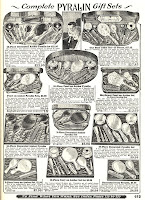

In several books, the Object of Desire
that symbolizes all to which our heroine
aspires, is a silver toilet set :
sold as gift sets, these featured
brush, comb, hand mirror and often
other grooming accessories.
She's an ordinary girl who owns
the standard "ivorette" or "pyralin"
(both are terms for celluloid) set
that was sold to many a farm and
working class family through Sears
and Montgomery Ward catalogs. The Burton heroine looks down on her Sears lifestyle and wants the Fifth Avenue goods that the equally unhappy heroines of Arthur Train's novel have by the trunkful.


The prices of the high-end goods are just readable at maximum zoom --
But if you can't make them out, the Fifth Avenue suit prices are: $165.00 ; 89.50; and 98.50. In 1923 dollars!


We, the readers, know how hard the father (for single-gal Burton heroines still at home) or the newlywed husband works to give her the nicest things he can, and we hurt for them, especially for the husband, as she spends him into the poorhouse, running up debt on clothes and perfumes and in one case, her own snappy roadster. Through various means, she grows up. She realizes how stupid her values are, how much she has hurt those she loves, and she settles into an appreciation of making dinners and of evenings at home sewing by the hearth with her rat-race-exhausted, but now-happy husband.

Happiness is easy to come by. A young lady reading these books undoubtedly felt that these fine, responsible guys were everywhere, despairing of all the flighty good-time girls and wishing for a good woman. And that all she had to do was to keep a good house, love the celluloid hairbrush because he gave it to her, mend her much-worn frocks, and have such a great guy fall at her feet.

Burton's plots and characters are simple and largely unshaded, but she's smart enough to address women's rootlessness while she provides a simple Return To Domesticity as the healer for it. She acknowledges the attractions that the fast new world holds for girls who have no sense of purpose in this cynical jaded society. But she also brings an essentially smart insight that throwing out the hypocrisy of Victorian society doesn't mean throwing out all commitment, work ethic and honesty, an insight which probably rang true to readers who'd danced at the parties and done the petting and found themselves feeling that life needed something of more substance.

And in Train's novel, Domesticity is also the answer. The eldest daughter in the abusive upper-crust marriage must content herself with motherhood, raising her children in America and remaining legally fettered to an odious husband. Lifelong celibacy is the only honorable option.

So there you have it. Women hunger for something of substance, but to both authors, it lies in the home. In Train's serious novel and in Burton's formulaic ones, the answer is for women to go backward into domesticity, not forward into -- duh !-- education for expansion of the mind and heart. This, even though Train perceived the value education had for the souls of boys.

The Good Ol' Days? Not by a long shot!

------

SOURCES:

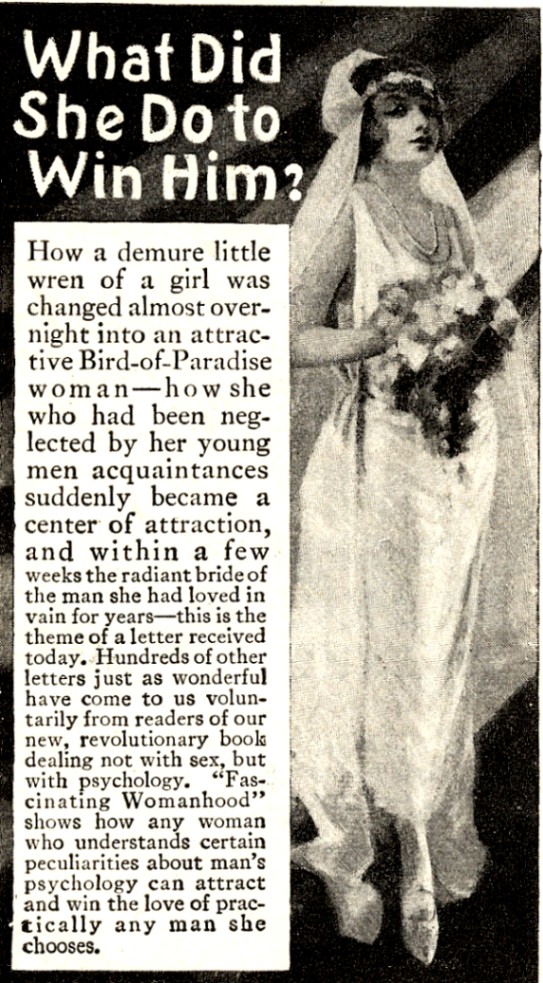
Top illustration is from an ad for an advice book to young women,

entitled Secrets of Fascinating Womanhood.
The ad is found in the June, 1924, issue of Modern Priscilla magazine,
THE magazine of homemaking how-to.

Pyralin items catalog page is from:

1927 Edition of the Sears, Roebuck Catalog: The Roaring Twenties.
Edited by Alan Mirken. Bounty Books, 1970. LC number: 78-108061

Suit illustrations:

Franklin Simon Fashion Catalog for 1923.
Dover Publications, c.1993. ISBN: 0-486-27854-9

and
Everyday Fashions of the Twenties, as Pictured in Sears and Other Catalogs.
Edited by Stella Blum. Dover Publications, 1981. ISBN: 0-486-24134-3

Sunday, July 24, 2011

The Dry Grass of August


The Dry Grass of August seems, at first, to be a simply told, straightforward story. Very reader-friendly, and full of interesting and heartachingly real characters. I found it hard to put down.

That simplicity is deceptive. It’s hard as all getout to put such a novel together this near-seamlessly.

This is the story of the Watts family and their dynamics, their secrets, their major (I know, we’re all sick of the term but) dysfunction.

It’s also the story of the late summer of 1954, in which the chronic tension of southern society during the Jim Crow era is becoming acute. Brown vs. Board of Education has everybody on edge. Violence against African Americans explodes under the pressure that a changing world levies on racists who hate the thought of that change.

Writing good fiction about an important time in history is hard for three reasons.

One is that it’s hard to tell the historic story and still tell a personal, individual story about the characters. They can end up being Symbols of events and issues, instead of people you believe in and care about.

Another is the need to do justice to the historic event. That means finding some way to view events through your fictional characters.

That kind of leads into the third hard part, which is sort of the Boolean intersection between the first two : the point of view problem. How many characters’ points of view will you need to speak through? Can one person tell the whole story or do you need multiple viewpoints in order to avoid having some intrusive narrator stop the story to give a history lecture?

The single point of view of a 13-year-old suburban white girl takes us through this hot and dangerous August. In alternating chapters, Jubie tell us her memories of her family as they grew more prosperous but more emotionally estranged. These memories alternate with chapters that take place during and after a road trip that the family is taking, from suburban Charlotte, NC, through the deep south.

There are four children in the Watts family. The two eldest who drive the story are Stell, 16, and June, “Jubie,” 13.

Author Anna Jean Mayhew’s first smart decision was to avoid making Jubie the gawky, underdeveloped wallflower-type who envies a more-noticed-by-boys older sister.

Jubie is nothing of the kind, and three cheers for that! The sisters fight and differ, but like and respect each other. Jubie is attractive and brave. And so is Stell, whose religious conversion spurs her curiosity about faith. Stell’s explorations lead the sisters into major events in the novel.

Crafting a plot that would take a 13-year-old girl through every nook and cranny that puts together the pieces of this story seems a daunting task to me. Sure, you can contrive ways for a single viewpoint-character to be everywhere she needs to be and see or hear enough to piece it all together, but usually it would seem exactly that. Contrived.

Mayhew solves that problem nicely through a couple of means. The device of the road trip lets us see the dynamics of the mother and children, their reactions to strangers in strange places, their interaction with the Florida relatives they visit, their coping with disaster.

More importantly, this is in part Jubie’s coming-of-age story, and Jubie takes an active part in expanding her own world. She’s smart enough to seek answers without alienating the people of whom she asks questions, and determined enough to go where the answers are, permission be damned. Her discoveries seem not only likely but inevitable.

Racism in the segregationist era had many faces. The Watts family lives the genteel version, in which everyone has “help” and believes that they treat them respectfully. The successful folks in the nice neighborhoods abhor the n-word. But as the Watts family drives through the deep, small town south, they encounter white trash ignorance and violence, and the consequences are tragic when their black maid, Mary, is abducted by a crew of enraged white drunks.

If the novel has a flaw, it could be its lack of an explanation for the beatings Jubie receives from her father. He’s a drunk and sometimes loving but sometimes violent, and of his children, only Jubie is ever on the receiving end of beatings.

Why? Even in the procession of family flashbacks Jubie doesn’t tell us when it started or what the original pretext was. Jubie is a questioner and questioners make dishonest people uncomfortable. That she would be his chosen target is not so much implausible as it is simply unspoken. This omission is kind of like an unpainted spot on a large and otherwise detailed and skilfully painted canvas.

Just as her father finds Jubie more of a threat than he does the other children, Mary finds her more of a kindred spirit, and the bond between the two is one of respectful knowledge and equality. Jubie runs away to attend Mary’s funeral in Mary’s church, and through her eyes we see the strength and world-changing force of the black church in the era of the Civil Rights movement. The black community has questions and will not take silencing for answers.

The officiant speaks on Isaiah 5:24, from a wonderful chapter which rails furiously against oppression and injustice :
Therefore as the tongue of fire devours the stubble, and as dry grass sinks down in the flame, so their root will be as rottenness, and their blossom go up like dust ...
The truth about Mary’s life and death, and the self-evident truth about the civil rights of all people are both coming, relentless as the fire that obliterates the dry grass. It’s August, folks.

Although it contains some horrific events and a pretty frank depiction of a family’s downfall, the levelheaded, sensitive narrator and the respect that the story gives to a panorama of characters give it true class. It’s a great book for teenagers whose parents don’t mind them reading hard realism if it’s done with class. But isn’t geared to teens and some things in it require adult understanding.

This terrific little novel deserves a LOT of attention.

Wednesday, June 29, 2011

Printing books in 1947!

I started out laughing at this video ... but quickly became absolutely fascinated!

Those were the days! Oh, and gotta love them hard-workin' "girls"!